

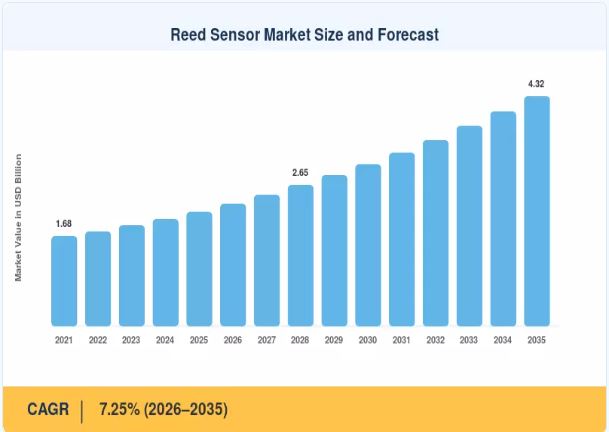
Reed Sensor Market Size Expected to Grow from USD 2.30 Billion in 2026 to USD 4.32 Billion by 2035
Reed Sensor Market
Reed Sensor Market Size, Share and Research Report By Mounting Type (Surface Mount (SMD), PCB Through-Hole, Threaded Barrel, Flange/Flat Pack, Cylindrical
Reed Sensor Market: The Reed Sensor Market is expanding as reliable magnetic sensing gains adoption across automotive, industrial, security, and consumer applications.”
NEW YORK,, NE, UNITED STATES, September 18, 2026 /EINPresswire.com/ -- ➤ Market Overview— Market Research Future (MRFR)
The Reed Sensor Market closed 2025 at USD 2.15 billion and enters the forecast window at USD 2.30 billion in 2026, climbing to USD 4.32 billion by 2035 at a 7.25% CAGR. This expansion reflects the steady retirement of mechanical limit switches, mercury-wetted tilt devices, and bare optical interrupters in favor of hermetically sealed, glass-encapsulated reed elements across automotive, industrial automation, consumer electronics, and utility metering applications.
Asia-Pacific commanded 37.3% of the Reed Sensor Market in 2025, supported by extensive Chinese, Japanese, and Taiwanese glass-tube manufacturing capacity, deep consumer electronics supply chains, and growing electric-vehicle production. Manufacturers in the region benefit from vertically integrated blade forming and overmoulding operations that keep landed costs competitive against global buyers.
Europe is advancing at an 8.83% CAGR across the forecast period, making it the fastest-growing region for reed sensors. Battery safety regulation, functional-safety certification requirements, and large-scale smart-metering rollouts are pushing designers toward hermetically sealed switching elements that can be certified without added barrier circuitry.
North America generated USD 0.55 billion in 2025 revenue, supported by automotive tier-one qualification programs, medical device manufacturing, and federally funded EV-charging infrastructure that specifies sealed interlock sensing for high-voltage cabinets. Businesses are increasingly favoring components with long field histories and documented reliability over newer solid-state alternatives in safety-critical sockets.
Download Sample Pages of Research Overview -
https://www.marketresearchfuture.com/sample_request/6707
➤ Reed Sensor Industry Landscape
Reed sensors are hermetically sealed, magnetically actuated switches that close or open an electrical contact when a magnet moves within range of the glass envelope. Because the contact operates in a sealed, gas-filled tube, reed sensors resist dust, moisture, vibration, and contamination that would degrade an unsealed mechanical switch, and they draw no standby power while at rest. These characteristics make them a default choice wherever engineers need reliable position, level, or proximity sensing without the cost and complexity of a powered semiconductor alternative.
The growing complexity of electrified and automated systems is strengthening demand for these components. Vehicles, industrial machines, and consumer devices increasingly combine dozens of sensing points across doors, fluid reservoirs, cylinders, and safety interlocks, creating design challenges involving durability, certification, and total installed cost. Reed sensor suppliers help original equipment manufacturers address these challenges through glass-to-metal sealing expertise, contact-material engineering, and application-specific packaging.
➤ Industrial Automation Market
The Industrial Automation Market is a relevant topical authority keyword because factory retrofit and robotics programs depend heavily on position feedback, cylinder homing, and machine-safety interlocks, all of which are common reed sensor sockets. As plants modernize production lines, they require rugged sensing components that tolerate welding electromagnetic interference, lubricant mist, and continuous duty cycles without added wiring complexity.
The connection between industrial automation and reed sensors demonstrates how electromechanical switching remains foundational to modern manufacturing even as software-defined controls advance. As organizations deploy more automated cells and mobile robots, they require sensing elements that can be installed quickly, certified against safety standards, and trusted to operate for years without maintenance. These requirements create ongoing opportunities for reed sensor suppliers across automation, robotics, and adjacent industrial technology sectors.
➤ Key Growth Drivers
Vehicle electrification remains a major growth driver for the Reed Sensor Market. Automakers are adding service disconnects, coolant-level floats, and charge-port interlocks to traction-battery packs, and each of these functions typically requires a spark-free, hermetically sealed switching element. As passenger platforms migrate from 400V to 800V architectures, demand is shifting toward higher-voltage-rated reed sensors capable of interrupting current without contact welding.
Functional safety and certification requirements are another significant factor supporting industry expansion. Reed switches offer directly observable contact states that simplify diagnostic assessments under standards such as IEC 61508, and intrinsic-safety approvals for hazardous areas cover glass-encapsulated designs without additional barrier electronics. Suppliers increasingly emphasize documented certification packages, allowing customers to reduce compliance costs and shorten qualification timelines.
➤ Electrification and High-Voltage Charging Infrastructure
High-voltage disconnect and charging infrastructure is creating substantial opportunities because traction packs, DC fast-charging cabinets, and solar-string monitors all require arc-free interruption at voltages that challenge conventional semiconductor switching. Different applications may have different requirements related to isolation, current rating, or response time. Reed sensor suppliers can address these needs through optimized glass length, epoxy damping, and rated contact materials engineered for inductive loads.
Battery-powered and wireless sensing nodes are also becoming more common as businesses deploy asset trackers, door contacts, and remote monitoring devices on constrained power budgets. However, continuous-draw sensing technologies can quickly exhaust a coin-cell battery. Latching reed elements address this challenge by holding contact state without power, extending field service intervals and reducing the total cost of ownership for distributed sensor fleets.
➤ Industrial Automation and Smart Manufacturing
Industrial automation and robotics are transforming reed sensor demand by adding position-feedback points across pneumatic cylinders, conveyor systems, and automated guided vehicles. Brownfield factories are adding sensing points faster than they are adding machines, and threaded-barrel and cylindrical reed sensor formats can be retrofitted into existing equipment without bracket redesign or new wiring harnesses.
Condition-monitoring capabilities can also extend the value of reed sensors beyond simple position detection. Cycle-count data generated by cylinder-mounted switches can be analyzed to predict seal wear and schedule maintenance before failures occur. As enterprises increasingly digitize plant operations, the demand for sensing components that can support predictive-maintenance data streams is expected to rise, creating an important intersection between reed sensors, edge connectivity, and industrial analytics.
Buy Now Get Comprehensive Market Insights -
https://www.marketresearchfuture.com/checkout?currency=one_user-USD&report_id=6707
➤ Safety Certification and Regulatory Compliance
Safety certification and regulatory compliance are increasingly central to reed sensor design-ins. Organizations operating in automotive, medical, and hazardous-area industries must meet standards such as IATF 16949, ISO 13485, and IEC 60079 while managing cost and lead-time pressures. Suppliers that maintain documented qualification histories and certification packages can help customers reduce compliance risk and accelerate program timelines.
Regulatory restrictions on legacy materials are also reshaping the competitive landscape. Directive 2011/65/EU and related RoHS exemption reviews have removed the last commercial justification for mercury-wetted contacts in most European applications, pushing designers toward dry-reed alternatives with nanostructured contact plating. Suppliers that can demonstrate compliant materials and requalified part families are positioned to gain share as legacy designs are phased out.
➤ Product Segmentation
The Reed Sensor Market can be segmented across mounting type, contact position, switching capability, and application. Surface Mount (SMD) devices lead on mounting format because automated pick-and-place assembly removes hand-insertion labor from high-volume consumer boards, while threaded-barrel and float-level formats serve retrofit and fluid-level applications that favor drop-in compatibility.
Form A (normally open) contact configurations represent a high-value segment because fail-safe logic is treated as mandatory in alarm and liquid-level applications. Latching (Form E) contacts are gaining importance as battery-powered and wireless sensing nodes proliferate, since these devices help enterprises extend field service intervals while reducing the complexity of maintaining continuously powered sensing circuits.
➤ Adoption Across Industries
Automotive manufacturers remain important customers because they operate complex electrified platforms and often qualify sensing components years in advance of production. These organizations require documented reliability, long field histories, and rated cycle counts. Reed sensor suppliers allow them to source proven components while internal engineering teams concentrate on higher-value systems integration.
Consumer electronics and appliance manufacturers are also an important customer segment. Smaller device makers may lack the resources required to qualify custom semiconductor sensing solutions for every lid, door, or interlock function. Reed sensor suppliers can give these organizations access to low-cost, catalog-ready components through standardized packages, allowing them to add reliable sensing without extensive internal engineering investment.
➤ Regional Insights
Asia-Pacific held 37.3% of the Reed Sensor Market in 2025, reflecting its dominant glass-tube manufacturing base and deep consumer electronics and electric-vehicle supply chains. The region benefits from vertically integrated producers, expanding EV pack production, and rising demand from India's utility metering programs, which together support continued growth across both commodity and precision sensor grades.
Europe is projected to advance at an 8.83% CAGR throughout the forecast period, the fastest of any region. Battery safety regulation, machinery safety documentation requirements, and large-scale smart-metering mandates are increasing demand for certified, hermetically sealed switching elements across the region's automotive and utility sectors.
North America generated USD 0.55 billion in 2025, reflecting its established automotive qualification base and growing electric-vehicle charging infrastructure. The region benefits from federally funded charging programs, medical device manufacturing clusters, and defense and aerospace applications that value proven hermetic sealing performance.
The Middle East and Africa is developing as an important opportunity, advancing at roughly a 7.94% CAGR as hazardous-area oil and gas instrumentation, industrial diversification programs, and utility modernization initiatives increase demand for intrinsically safe, certified sensing components across the region.
➤ Emerging Opportunities
One of the most significant opportunities involves high-voltage disconnect components for electrification and charging infrastructure. Businesses increasingly need sensing elements rated above 200V to support 800V vehicle platforms and megawatt charging systems. Providers capable of delivering certified, arc-free switching at these voltage levels can create differentiated offerings within the broader sensing ecosystem.
Another opportunity is the development of condition-monitoring and data services layered on top of standard sensing hardware. Healthcare, industrial automation, and utility metering organizations have different compliance, durability, and connectivity requirements. Providers that combine reed sensing with edge gateways and predictive-maintenance analytics can offer more targeted solutions and build stronger, recurring-revenue customer relationships.
➤ Key Challenges
Despite strong growth potential, the industry faces several challenges. Hall-effect and tunneling-magnetoresistance solid-state alternatives increasingly compete for low-voltage, high-volume sockets where continuous position data is valued over simple binary state, making differentiation on durability and certification a critical requirement. Enterprises may also encounter precious-metal cost volatility, since ruthenium and rhodium plating account for a meaningful share of switch bill-of-materials cost in high-cycle grades.
Glass-tube miniaturization limits remain an ongoing concern. Reed sensors have a physical floor on how small a sealed glass envelope can be manufactured, and wearables or slim consumer devices increasingly fall below that threshold. Supply-base concentration can also have significant consequences, since a small number of specialized glass-to-metal sealing facilities worldwide makes lead times and dual-sourcing mandates essential components of a resilient procurement strategy.
➤ Future Outlook
The Reed Sensor Market is expected to maintain steady expansion as electrification, industrial automation, and utility modernization programs increasingly rely on hermetically sealed sensing components for mission-critical applications. Growth from USD 2.15 billion in 2025 to USD 4.32 billion by 2035 represents a substantial increase in demand for high-voltage switching, latching architectures, and certified safety components.
Future development will increasingly center on high-voltage migration, condition-monitoring data services, nanostructured contact materials, and regional supply-chain resilience. Providers that can combine technical expertise with certification depth, cost optimization, and flexible packaging will be well positioned to capture long-term opportunities.
Browse Full Report Details -
https://www.marketresearchfuture.com/reports/reed-sensor-market-6707
➤ Key Takeaways
The Reed Sensor Market is being shaped by vehicle electrification, industrial automation retrofits, utility metering rollouts, functional-safety requirements, and materials-science advances in contact plating. Asia-Pacific remains the leading regional contributor on manufacturing scale, while Europe demonstrates the strongest growth potential and the Middle East and Africa benefits from hazardous-area instrumentation and utility modernization investments.
The migration toward higher voltage ratings and latching architectures will increasingly redefine product mix. At the same time, related technology areas such as the Industrial Automation Market demonstrate the growing requirement for rugged, certifiable, and low-power sensing components. As businesses prioritize reliability and total cost of ownership, reed sensors are expected to remain a strategic component of electrified and automated systems.
➤ Frequently Asked Questions
How do reed sensors compare with Hall-effect devices on total installed cost?
Reed elements avoid power routing and signal conditioning, landing near USD 18 per installed point versus about USD 34 for Hall equivalents in retrofits. Hall devices win where continuous position data is required
What qualification credentials matter most when sourcing in the Reed Sensor Market?
Look for IATF 16949 for automotive, ISO 13485 for medical, and documented IEC 60079 intrinsic-safety approval for hazardous areas. Missing credentials add quarters to programme timelines
➤➤➤ Industry Analysis Reports by Market Research Future:
Volte Technology Market-
https://www.marketresearchfuture.com/reports/volte-technology-market-1402
Silicon Wafers Market-
https://www.marketresearchfuture.com/reports/silicon-wafers-market-2052
Embedded Software Market-
https://www.marketresearchfuture.com/reports/embedded-software-market-2103
Intelligent Railway Transport System Market-
https://www.marketresearchfuture.com/reports/intelligent-railway-transport-system-market-2123
System On Chip Market-
https://www.marketresearchfuture.com/reports/system-on-chip-market-2207
Active Electronic Components Market-
https://www.marketresearchfuture.com/reports/active-electronic-components-market-2284
Public Cloud Market-
https://www.marketresearchfuture.com/reports/public-cloud-market-2291
Wearable Technology Market-
https://www.marketresearchfuture.com/reports/wearable-technology-market-2336
Machine Control System Market-
https://www.marketresearchfuture.com/reports/machine-control-system-market-2384
Semiconductor Assembly And Testing Services Market-
https://www.marketresearchfuture.com/reports/semiconductor-assembly-testing-services-market-2415
Market Research Future
Market Research Future
+ +1 855-661-4441
email us here
Legal Disclaimer:
EIN Presswire provides this news content "as is" without warranty of any kind. We do not accept any responsibility or liability for the accuracy, content, images, videos, licenses, completeness, legality, or reliability of the information contained in this article. If you have any complaints or copyright issues related to this article, kindly contact the author above.
